
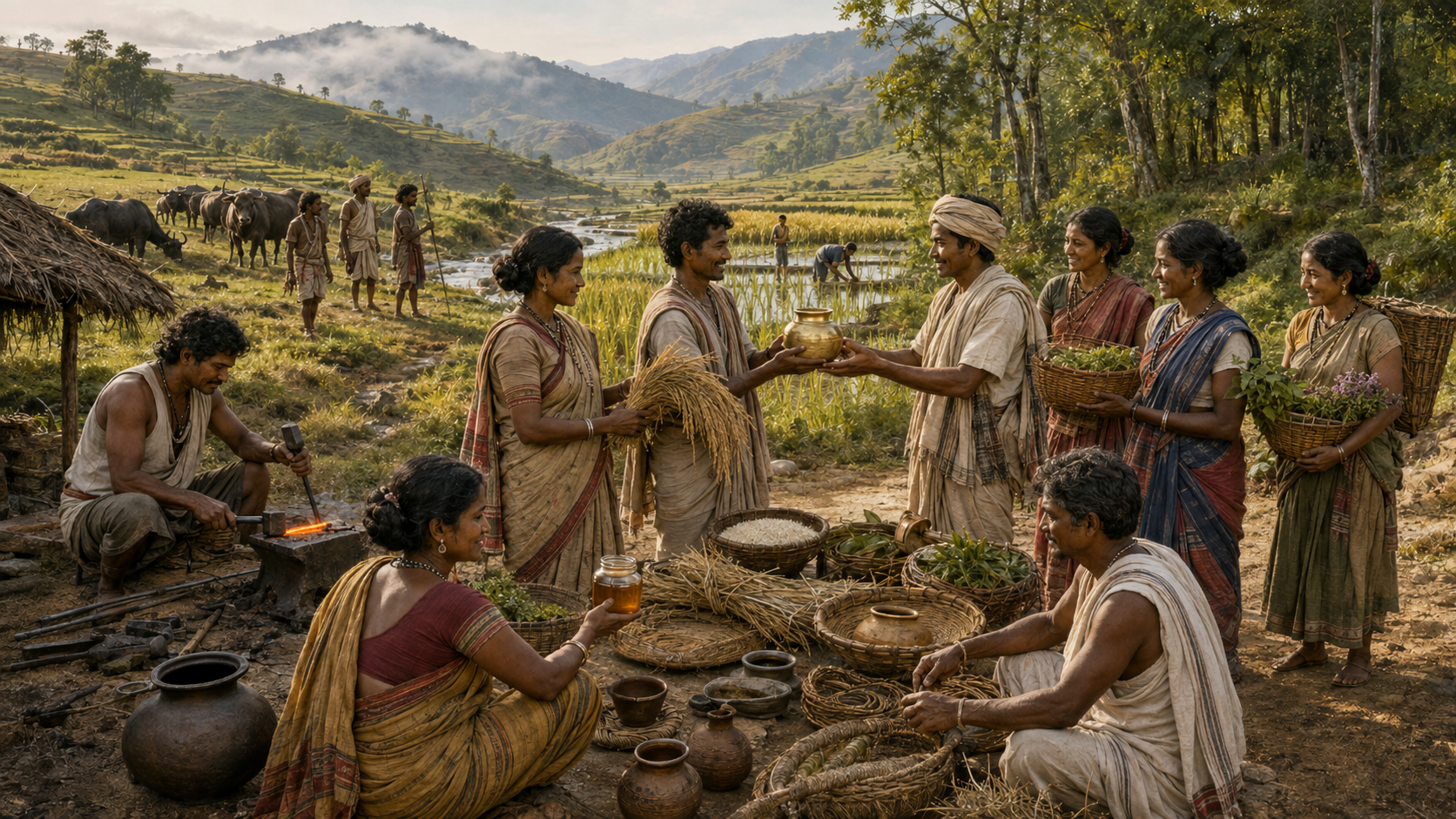
Tribal communities in India have never existed as isolated or completely self-sufficient groups.
Across different ecological regions, neighbouring communities developed specialised occupations and depended upon one another for food, tools, forest produce, labour, music and ritual services. From the Nilgiri Hills to Central India, Chota Nagpur, Arunachal Pradesh and Wayanad, these inter-tribal systems reveal complex networks of exchange, cooperation and, at times, inequality.
This article examines five such systems and explores how colonial policies, markets, legislation and modern development transformed these traditional relationships.
Nilgiri Tribal Complex: Toda, Kota, Kurumba & Irula (Tamil Nadu)
The Nilgiri Hills of Tamil Nadu are home to one of the most anthropologically significant examples of formalised inter-tribal symbiosis in South Asia. The Toda, Kota, Kurumba, and Irula, alongside the immigrant Badaga agriculturalists, formed a tightly interlocked socioeconomic system grounded in ecological complementarity, occupational specialisation, and ritual interdependence.
W.H.R. Rivers, in his foundational study The Todas (1906), first brought this system to scholarly attention, and Paul Hockings later documented its transformation under modernity.
This inter-tribal network is often compared with the plains jajmani system, though it is rooted in tribal rather than caste-based social relations.
- The Toda occupied the plateau grasslands and were exclusively pastoral, maintaining sacred and ordinary buffalo herds. They supplied dairy products like ghee, milk, and butter to other communities and received grain, crafts, and ritual services in return.
- The Kota served as the artisan-musicians of the system. They produced iron tools, pottery, and leather goods for all neighbouring groups, and performed music at the funerary and ceremonial occasions of the Toda and Badaga, an obligation that was simultaneously economic and cosmological.
- The Kurumba, living in the deep forests, combined forest product collection (honey, roots, timber) with a critical ritual niche – they were feared as sorcerers whose protective and curative services were indispensable to both Toda and Badaga households, maintained through hereditary patron-client ties.
- The Irula occupied the forest margins and lower slopes, supplying game, forest produce, and seasonal agricultural labour.
Mandelbaum observed that exchange within this system was not merely transactional, but it was ritually embedded, making inter-tribal bonds culturally inalienable.
Colonial plantation agriculture disrupted Toda grazing lands, mass-produced goods eroded the Kota’s artisan monopoly, modernisation and Christianisation weakened belief in Kurumba sorcery and forest legislation marginalised Irula livelihoods.
The Nilgiri inter-tribal system exemplifies how ecological differentiation, occupational specialisation, and ritual complementarity can sustain a self-regulating exchange network among tribal communities. However, under the combined pressures of market integration, colonial land alienation, formal education, and wildlife conservation laws, this symbiosis has shifted from mutual interdependence to competitive co-existence.
The Nilgiri case remains a critical point for understanding both the resilience and the vulnerability of indigenous socioeconomic systems in contemporary India.
W.H.R. Rivers (The Todas, 1906) | M.B. Emeneau | Paul Hockings | David Mandelbaum | B.H. Bhanu
Central India Complex: Gond, Baiga, Agaria & Pardhan (MP & Chhattisgarh
The forested highlands of Madhya Pradesh and Chhattisgarh host a complex web of inter-tribal interdependence among the Gond, Baiga, Agaria, and Pardhan communities. This system, documented extensively by Verrier Elwin, bears a remarkable structural resemblance to the Nilgiri tribal complex – with distinct ecological niches, occupational specialisations, and ritual roles creating mutual dependencies across communities.
This Central Indian network emerged organically from tribal social relations embedded in the forest economy of the Satpura and Maikala ranges.
- The Gond, numerically and politically the dominant group of central India, were primarily agriculturalists and forest dwellers who maintained hereditary relationships with specialist communities for craft, ritual, and bardic services.
- The Agaria, a small iron-smelting tribe, occupied an artisan niche identical in function to the Kota of the Nilgiris extracting ore from the Maikala range and producing ploughshares, axes, sickles, and mattocks that the Gond and surrounding communities depended upon for agriculture. Elwin documented the Agaria’s profound ritual relationship with iron stating that they were not merely blacksmiths but custodians of a sacred metallurgical tradition.
- The Baiga played a role closely parallel to both the Kurumba and the Toda. Recognised by the Gond and Kol as the most ancient inhabitants of the region, the Baiga were respected as priests with special knowledge of the soil and forest. They practised bewar (slash-and-burn cultivation) and refused to use the plough as a matter of cosmological principle. Other tribes employed them for their curative, divinatory, and ritual protection services.
- The Pardhan served as the bardic community – oral historians, genealogists, and musicians of the Gond – maintaining and transmitting the Gond’s mythological corpus through song and recitation. They received grain, land-use rights, and gifts in return.
Together, these four communities formed an ecologically and ritually integrated system where no single group was economically self-sufficient.
Colonial land settlement, forest reservation, and the push toward settled agriculture, particularly the forced settlement of the Baiga, fundamentally disrupted these interdependencies.
The Central Indian inter-tribal complex reveals how specialised ecological roles like iron-smelter, ritual agriculturalist, sorcerer-priest, and bard can produce a durable system of mutual dependence without formal caste hierarchy. As Verrier Elwin observed, these relationships were not mere economic transactions but expressions of a shared cosmological order in which each community had a defined place.
The erosion of this system under colonial and post-colonial development policies underscores the anthropological cost of development that ignores indigenous social architecture.
Verrier Elwin (The Baiga, 1939; The Agaria, 1942) | W.V. Grigson (The Maria Gond, 1938) | Stephen Fuchs | Shamrao Hivale
Chota Nagpur Complex: Santal, Munda, Ho, Oraon & Birhor (Jharkhand–Odisha)
The Chota Nagpur Plateau of Jharkhand and contiguous parts of Odisha and West Bengal is home to one of the most densely tribal regions of India, where multiple communities like the Santal, Munda, Ho, Oraon, Birhor, Lohar, and Mahali maintained structured patterns of inter-community interdependence grounded in ecological differentiation and occupational specialisation.
S.C. Roy, the pioneering ethnographer of the region, documented these relationships in detail, revealing a system in which settled agriculture, forest foraging, artisan production, and ritual service were distributed across distinct communities in a manner functionally analogous to the jajmani networks of the plains.
The Munda and Ho were the dominant agricultural communities of the upland plateau, cultivating rice and millets under their distinctive khuntkatti (joint ownership) land tenure system.
The Santal, occupying the eastern and lowland margins, were also primarily agriculturalists with a particularly strong tradition of forest clearance and settlement.
The Birhor, a semi-nomadic hunting and rope-making community, occupied the most ecologically specialised niche. S.C. Roy documented how the Birhor supplied rope (made from forest creepers), monkey meat, and forest medicines to surrounding agricultural tribes in exchange for grain and cooked food. This asymmetric exchange was hereditary and personalised, resembling the jajman-kamin bond.
The Mahali served as basket-makers, supplying woven goods to all surrounding communities.
The Lohar (blacksmiths), though technically a caste group, functioned within the tribal exchange network by providing iron tools representing a blurring of the tribe-caste boundary that Nirmal Kumar Bose theorised as the “Hindu method of tribal absorption.”
The Oraon maintained distinct ritual and agricultural identities while interacting economically with both Munda and Santal settlements.
Colonial extraction of forest resources, the introduction of the zamindari system, and the influx of non-tribal dikus (outsiders) progressively marginalised the Birhor and disrupted the Mahali’s artisan role – two communities now classified as PVTGs.
The Chota Nagpur inter-tribal system demonstrates that functional interdependence, ritual complementarity, and hereditary exchange partnerships are not exclusive to the plains jajmani model but emerge naturally within tribal ecologies as well.
The disintegration of this system driven by colonial forest policy, diku migration, and Christian missionary influence precipitated the Santal Hul (1855–56) and the Munda Ulgulan (1899–1900), underscoring how the destruction of indigenous socioeconomic arrangements produces not merely economic deprivation but existential crisis for tribal communities.
For contemporary policy, the case of the Birhor and Mahali as PVTGs illustrates the long-term consequences of ignoring traditional livelihoods.
S.C. Roy (The Mundas, 1912; The Birhors, 1925) | K.S. Singh | L.P. Vidyarthi | Nirmal Kumar Bose | W.G. Archer
Northeast India: Apa Tani, Nishi & Hill Miri (Arunachal Pradesh)
The Subansiri district of Arunachal Pradesh presents one of the most fascinating examples of structured inter-ethnic interdependence in Northeast India, involving the Apa Tani, Nishi (Dafla), and Hill Miri communities. Christoph von Fürer-Haimendorf, who conducted fieldwork among the Apa Tani in the 1940s, documented a sophisticated system of trade, barter, debt bondage, and peace-pact diplomacy that bound these three communities in a durable web of exchange.
Unlike the ritual symbiosis of the Nilgiri or the artisan interdependence of Central India, the Apa Tani system was characterised by marked ecological contrast and formal inter-community trade institutions.
- The Apa Tani occupied a small valley of extraordinary agricultural productivity, practising intensive wet rice cultivation using an elaborate system of irrigation channels and fish-cum-paddy cultivation which is one of the most sophisticated forms of tribal agriculture documented in South Asia. Despite their small population of approximately 15,000, they produced a surplus of rice that the surrounding Nishi and Hill Miri, who were forest-dependent swidden cultivators, could not match. This ecological asymmetry formed the basis of the inter-tribal exchange system.
- The Nishi, inhabiting the forested hills surrounding the Apa Tani valley, supplied the Apa Tani with forest products like wild game, timber, thatch, and most critically, debt bondspeople (poge) in exchange for rice, iron tools, brass ornaments, and cotton cloth. Von Fürer-Haimendorf documented the poge system as a formalised institution of debt-bondage in which Nishi individuals in economic distress would enter temporary service in Apa Tani households, with clearly defined rights and obligations on both sides.
- The Hill Miri maintained a more balanced exchange relationship with both communities, acting as intermediaries in trade networks connecting the valley to wider highland economies.
Peace pacts (mithun exchange ceremonies) formalised inter-community relations and created mechanisms for conflict resolution. The Apa Tani’s exceptional agricultural surplus also enabled them to accumulate wealth in the form of brass plates, beads, and mithun cattle, a prestige economy that structured social hierarchy within the community.
Post-independence administrative integration, the abolition of the poge system, and road connectivity have fundamentally altered these inter-ethnic dynamics.
The Apa Tani–Nishi–Hill Miri system is significant in anthropological literature for several reasons: it demonstrates how ecological advantage (wet rice surplus) can generate formal inter-ethnic trade institutions, including debt bondage, without requiring a caste framework.
Von Fürer-Haimendorf’s analysis reveals that tribal societies can develop complex economies of surplus and exchange through endogenous institutional innovation. The post-independence integration of the Apa Tani into the national market economy disrupted a millennium-old exchange equilibrium, raising important questions about the pace and cultural sensitivity of development interventions in ecologically and socially distinct tribal regions.
Christoph von Fürer-Haimendorf (The Apa Tanis and Their Neighbours, 1962) | Verrier Elwin | B. Blackburn | Tamo Mibang
Wayanad Complex: Paniya, Kurichiya & Kurumba (Kerala)
The Wayanad plateau of northern Kerala and its adjacent hill tracts present a layered pattern of inter-tribal interdependence that is both geographically proximate to and structurally distinct from the Nilgiri system. The Kurichiya, Paniya, and Kurumba communities, along with smaller groups such as the Kattunayakan and Adiya, maintained stratified but functionally complementary relationships embedded in local land tenure, agricultural labour, forest use, and ritual obligation.
P.R.G. Mathur and K. Raman Unni documented these relationships within the broader frame of tribal social organisation in Kerala, revealing a system in which social hierarchy and economic interdependence were mutually reinforcing.
- The Kurichiya occupied the dominant position in the Wayanad inter-tribal hierarchy. They were the primary cultivators practising wet rice and dry crop agriculture and maintained rights over relatively fertile valley land. The Kurichiya’s social organisation was characterised by strong community cohesion, hereditary headmen, and a martial tradition that gave them political leverage over neighbouring communities.
- The Paniya, whose name derives from the Malayalam word for work (pani), occupied a position of structural subordination as agricultural labourers. Historically, the Paniya were bound to Kurichiya and non-tribal Nair landlords under the adima system– a form of hereditary bonded labour unique to Kerala’s hill tracts. They cleared forests, tilled fields, harvested crops, and carried produce, receiving food, minimal wages, and the right to reside on the landowner’s premises. This relationship, while economically exploitative, also carried obligations of patron-client care.
- The Kurumba , specifically the Mullu Kurumba and Betta Kurumba sub-groups, occupied the deep forests of Wayanad, much as their counterparts did in the Nilgiris. They provided honey, forest produce, medicinal plants, and ritual services (including sorcery and protective magic) to both Kurichiya and Paniya communities, receiving grain and cooked food in return.
The abolition of the adima system through the Kerala Agricultural Workers Act (1974) and the Bonded Labour System (Abolition) Act (1976) disrupted the Paniya’s primary economic relationship. Simultaneously, forest conservation regulations constrained Kurumba forest access, while Kurichiya agricultural lands faced encroachment from migrant settlers.
Today, competition for welfare entitlements, land rights, and wage labour has replaced the older system of complementary exchange.
The Wayanad inter-tribal system is distinguished from the Nilgiri model by the explicit presence of social hierarchy and institutionalised labour bondage alongside economic complementarity.
The Paniya’s transition from bonded labourers to free wage workers represents a legal emancipation that paradoxically produced economic vulnerability. The Wayanad case demonstrates that the dissolution of inter-tribal interdependence, even when driven by progressive legislation, requires simultaneous investment in alternative livelihood systems for the most marginalised communities to benefit from change.
K. Raman Unni | P.R.G. Mathur | B.H. Bhanu (AnSI) | K.K.N. Kurup
Comparative Summary
| System / Region | Key Communities | Dominant Interaction | Key Scholar(s) |
| Nilgiri Hills, Tamil Nadu | Toda, Kota, Kurumba, Irula | Dairy–craft–sorcery–forest exchange; ritual embedding | Rivers, Hockings, Mandelbaum |
| Central India (MP, Chhattisgarh) | Gond, Baiga, Agaria, Pardhan | Agrarian–smelting–priestly–bardic symbiosis | Verrier Elwin, Fuchs |
| Chota Nagpur (Jharkhand, Odisha) | Santal, Munda, Ho, Oraon, Birhor | Agricultural–forager–artisan interdependence; jajmani parallel | S.C. Roy, Vidyarthi, Bose |
| Subansiri, Arunachal Pradesh | Apa Tani, Nishi, Hill Miri | Surplus rice trade; debt bondage (poge); peace pacts | Von Fürer-Haimendorf |
| Wayanad, Kerala | Kurichiya, Paniya, Kurumba | Hierarchical agrarian–labour–forest exchange; adima bondage | Mathur, Unni, Bhanu |
India’s inter-tribal systems demonstrate that economic exchange was deeply connected with ecology, social relations and cultural beliefs. Pastoralists, cultivators, artisans, forest gatherers, musicians and ritual specialists contributed different skills to a larger network of mutual dependence. However, these arrangements were not always equal; some also involved hierarchy, exploitation and bonded labour. Their decline therefore brought both freedom and new vulnerabilities. These systems helps us appreciate indigenous social organisation while reminding policymakers that reform must be accompanied by secure land rights, forest access and sustainable alternative livelihoods.
Until the next time…
— Kartic


Leave a Reply