
Fortnightly Digest · 3 October – 17 October 2026
For the UPSC Anthropology optional
Published Sunday, 18 October 2026
PAPER 1: GENERAL AND PHYSICAL ANTHROPOLOGY
Shanidar A evidence of Neanderthal trauma and care
- Syllabus Mapping: Paper 1, Unit 1.6 (Neanderthal Man and fossil hominids) & Unit 12 (Applications of Anthropology: forensic anthropology, personal identification)
The News
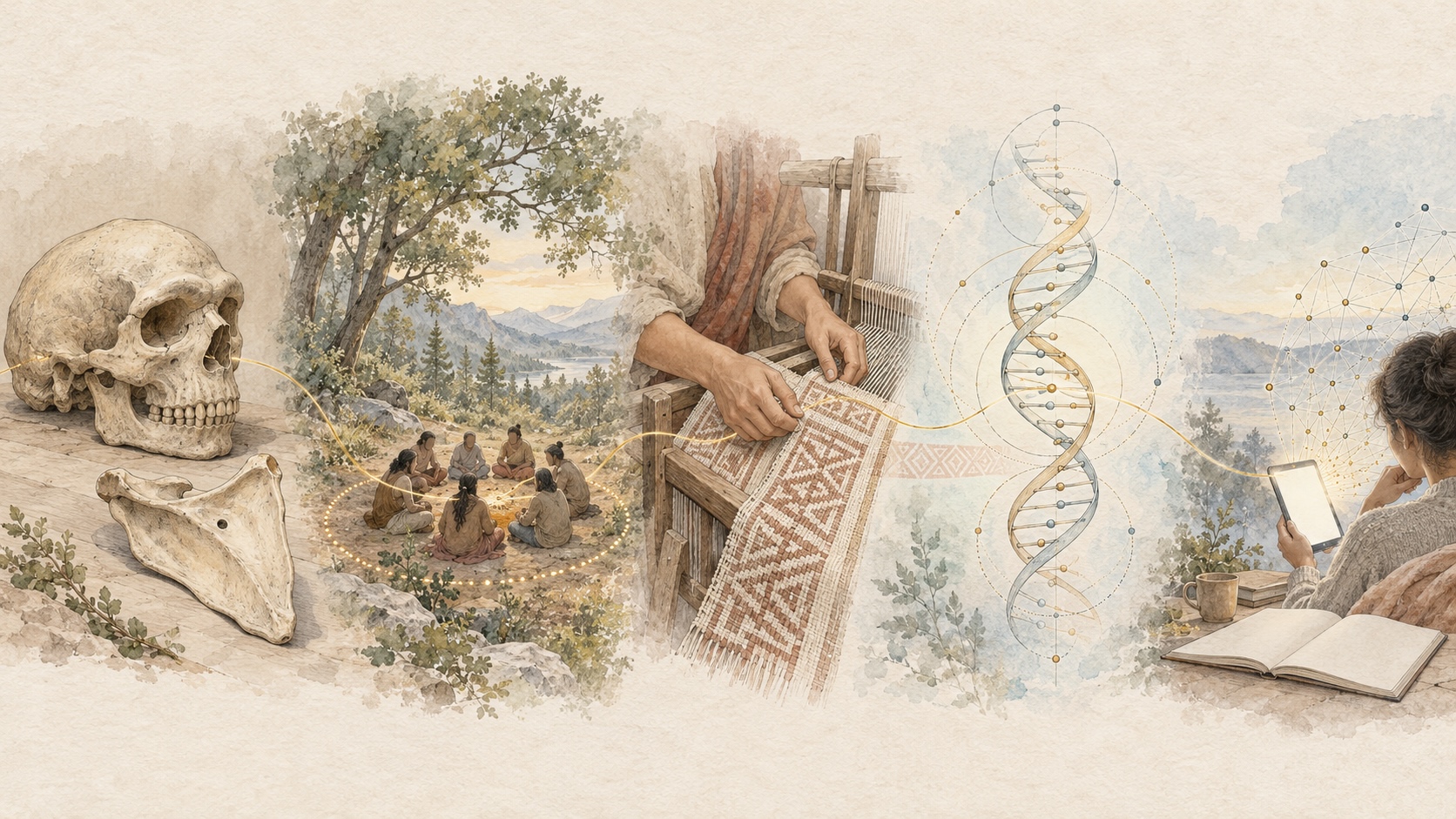
- A Scientific Reports paper dated 15 October 2026 examines Shanidar A, a Neanderthal from Iraqi Kurdistan about 75,000 years old. A 15 mm hole in the left shoulder blade suggests a penetrating injury near death. The team proposes a wooden spear wound, although a hunting accident remains possible. An older damaged tooth had calculus over its exposed root canal. This indicates survival after injury and may support an inference of care.
Explanatory Notes
- Scientific / Empirical Mechanism: The methods here are drawn straight from forensic anthropology, which is why the item serves Unit 12 as well as Unit 1.6. Three determinations do the work.
- First, the timing of the injury: antemortem trauma shows bone remodelling and healing, perimortem trauma shows the fracture characteristics of fresh, wet, collagen-rich bone (plastic deformation, bevelling, hinged or adhering fragments), and postmortem damage to dry bone produces sharp, square-edged breaks of a different colour from the surrounding surface. The Shanidar A lesion shows perimortem characteristics.
- Second, the direction of travel: internal bevelling marks an entry and external bevelling an exit. This is because a penetrating object carries a cone of bone outward as it leaves.
- Third, weapon class: wound morphology is matched against experimental impacts with replica weapons, a standard forensic procedure.
- The dental evidence runs on a separate mechanism. Dental calculus is mineralised plaque that accumulates continuously in life and ceases at death; its accumulation over an exposed root canal is thus a clock, and its presence establishes that the individual lived on for a considerable period after the tooth was split. A split incisor with inward rotation of the neighbouring teeth implies serious impairment of anterior biting, which in turn implies dietary modification by others.
Theoretical Synthesis
- The care hypothesis sits at the centre of the long argument over Neanderthal cognitive and social capacity. Erik Trinkaus, whose study of the Shanidar remains established the osteobiography of Shanidar 1, argued for considerable social support. Dettwyler’s 1991 critique warned that survival with impairment does not by itself show compassion, since many impairments are compatible with self-care.
- Penny Spikins and colleagues have since developed the bioarchaeology of care into a formal method, which requires that the severity of the impairment be modelled before inferring provisioning.
- This paper’s contribution is that the dental calculus supplies an independent duration estimate rather than resting on the impairment alone.
- The violence finding bears on the replacement debate in the relationship between Neanderthals and Anatomically Modern Homo sapiens. The African origin model and Multiregional model offer different accounts of human origins and Neanderthal relationships. Trauma adds evidence about Neanderthal life but cannot by itself settle these models. A proposed violent death must also be distinguished from organised warfare.
Essential Concepts and Terminology
- Perimortem trauma: Injury occurring at or around the time of death, identified by fracture patterns characteristic of fresh bone that still retains its organic collagen content and thus deforms plastically before failing.
- Bevelling: The cone-shaped widening of a penetrating wound in flat bone, with the narrow aperture on the entry surface and the wide aperture on the exit surface, used in forensic anthropology to establish direction of travel.
- Dental calculus: Mineralised dental plaque, which accumulates throughout life and preserves a record of duration as well as, increasingly, of diet and oral microbiota through ancient DNA and proteomic analysis.
- Osteobiography: The reconstruction of an individual life history from the skeleton, combining age, sex, stature, pathology, trauma, activity markers and diet, a term associated with Frank Saul and developed extensively in bioarchaeology.
- Bioarchaeology of care: A framework developed especially by Lorna Tilley, with contributions from scholars including Penny Spikins, for assessing impairment and possible care in the past. Inferences require evidence about the support an individual would have needed.
Case Study and Empirical Integration: This single skeleton is the most economical example available for a question on Neanderthal social behaviour. This is because one individual carries evidence of both care, through the healed dental injury and calculus accumulation over at least a year, and lethal violence, through the 15 mm perimortem scapular perforation. Use it alongside Shanidar 1 and against the simple assumption that organised interpersonal violence begins with farming.
Indigenous rights and biodiversity before CBD COP17
- Syllabus Mapping: Paper 1, Unit 12 (Applications of Anthropology: development, conservation and displacement) & Unit 6 (Anthropological theories)
The News
- Cultural Survival published an Indigenous-rights agenda before CBD COP17 in Yerevan, scheduled for 19–30 October 2026. It calls for Indigenous authority, secure territories, direct support and effective participation in conservation. The agenda links the Kunming–Montreal biodiversity targets with protection against dispossession. Conservation commitments need to be assessed alongside the rights of people living in those landscapes.
Explanatory Notes
- Contextualizing the News: The Convention on Biological Diversity recognises the importance of Indigenous and local knowledge. The Kunming–Montreal framework includes a target to conserve 30% of land and sea by 2030. Area-based targets can create conflict if protection displaces communities or restricts livelihoods. Rights-based conservation asks who makes decisions, who benefits and whose land rights are recognised.
- Legal and Policy Mechanism: Free, prior and informed consent is the operative legal standard and its four elements each carry weight. The standard appears in ILO Convention 169 of 1989, in Articles 10, 19, 29 and 32 of the UN Declaration on the Rights of Indigenous Peoples adopted in 2007.
- Free means without coercion, intimidation or manipulation.
- Prior means sufficiently in advance of authorisation or commencement of activities, respecting the community’s own decision-making timeframes.
- Informed means that the information supplied is adequate, accessible and in a comprehensible language, covering the nature, scale, duration, locality and likely impacts of the proposal.
- Consent means a collective decision made through the community’s own representative institutions, and, on the stronger reading advanced by Indigenous organisations, includes the right to withhold it·
- The distinction the delegation presses, between rights holder and stakeholder, is legally substantive rather than rhetorical: a stakeholder is consulted, while a rights holder’s consent is a condition of lawful action.
Theoretical Synthesis
- The critique of exclusionary conservation in anthropology runs from Raymond Bonner’s At the Hand of Man (1993) and Dan Brockington’s Fortress Conservation (2002) through Mac Chapin’s 2004 article challenging the large conservation organisations, to Paige West, James Igoe and Dan Brockington’s 2006 review of the social impacts of protected areas.
- The core finding is that the Yellowstone model, in which conservation requires the removal of resident populations, exported from the United States to Africa and Asia, produced conservation refugees on a very large scale, estimated in the millions.
- India’s own trajectory is the obvious comparison and should be used as such. The Wildlife (Protection) Act of 1972 and the Project Tiger programme of 1973 created the Indian protected-area system on the exclusionary model. The Forest Rights Act of 2006 was enacted in explicit acknowledgement of what its preamble calls the historical injustice done to forest dwellers; and Section 4(2) of that Act now governs relocation from critical wildlife habitats, requiring, among other conditions, the free informed consent of the gram sabha.
- India’s position in international forums, however, has long been that the term indigenous peoples does not apply in the Indian context, since all Indians are indigenous, which is why Indian Scheduled Tribes are not usually represented as Indigenous Peoples at these conferences.
Essential Concepts and Terminology
- Article 8(j): The provision of the Convention on Biological Diversity obliging Parties to respect, preserve and maintain traditional knowledge relevant to biodiversity, and to share benefits from its use equitably.
- Free, prior and informed consent (FPIC): The standard requiring that consent for activities affecting Indigenous lands or resources be obtained without coercion, in advance, based on adequate information, and through the community’s own institutions.
- Kunming-Montreal Global Biodiversity Framework: The 2022 global biodiversity agreement with four goals and twenty-three targets for 2030, of which Target 3 commits Parties to conserving thirty per cent of land and sea areas.
- Conservation refugees: People displaced from their lands by the establishment or expansion of protected areas, a category documented extensively in Africa, South and South-East Asia and Latin America.
- Rights holder versus stakeholder: The distinction between a party whose consent is legally required and a party whose views are merely to be considered. The central claim in Indigenous participation at multilateral environmental negotiations.
Case Study and Empirical Integration: Use the Target 3 commitment of thirty per cent by 2030 and the demand that conservation never cause dispossession as the international frame for Indian answers on the Forest Rights Act, critical wildlife habitats and tiger reserve relocation, and note India’s distinctive position on the applicability of the term indigenous.
Re-evaluating Epistemological Paradigms in Digital Ethnography
- Syllabus Mapping: Paper 1 (Section 8.1: Research Methods in Anthropology).
The News
- A theoretical paper published in American Anthropologist explores the methodological challenges and ethical frameworks of digital ethnography in an era dominated by algorithmic feed structures and AI-generated social interactions. The authors advocate for an “Augmented Thick Description” approach that combines digital trace analysis with traditional immersive participant observation to study online communities and virtual subcultures.
Explanatory Notes
- Contextualizing the News: As human social interaction increasingly migrates to digital platforms, social-cultural anthropology must update its field methods. Classical ethnographic techniques formulated by Bronislaw Malinowski relied on physical co-presence within defined geographical boundaries. Digital ethnography addresses non-spatial, multi-sited, and algorithmically mediated social fields.
Scientific / Empirical Mechanism
- Framework: “Augmented Thick Description” pairs computational scraping of unstructured textual/visual data with qualitative, semi-structured interviews and reflexive digital field notes.
- Ethical Considerations: Addressing “informed consent” in public vs. private online spaces, avatar-mediated identity verification, and data anonymization protocol under modern privacy laws.
Theoretical Synthesis
- The paper builds on Clifford Geertz’s interpretive framework of “Thick Description” and George Marcus’s “Multi-Sited Ethnography.” It argues that algorithms are not neutral channels but cultural artifacts and active social agents (Actants) within Bruno Latour’s Actor-Network Theory (ANT). Thus, digital spaces demand a re-examination of concepts like field site, culture, and informant.
Essential Concepts and Terminology
- Actor-Network Theory (ANT): A social theory framework proposing that human and non-human elements (e.g., software algorithms) hold equal agency within social networks.
- Algorithmic Agency: The capacity of automated algorithms to shape user behavior, structure communication networks, and generate cultural norms.
- Digital Co-presence: The experience of spatial and temporal togetherness created through electronic communication media, transcending physical distance.
Case Study and Empirical Integration: Integrate this into Paper 1 (Section 8.1: Research Methods in Anthropology). It serves as an excellent contemporary example when answering questions on non-traditional fieldwork methodologies, ethics in ethnographic research, and the evolution of qualitative research paradigms.
Indigenous Peoples Day and cultural appropriation
- Syllabus Mapping: Paper 1, Unit 5 (Religion: the sacred and the profane) & Unit 6 (Anthropological theories: cultural relativism and the ethics of representation)
The News
- The US observance of Indigenous Peoples’ Day fell on 12 October. It was followed by discussions about cultural appropriation and discussions distinguished buying an Indigenous-made product from using sacred practices or symbols without permission. The central questions concern control, meaning, compensation and Indigenous economic sovereignty. (Indigenous Peoples’ Day in the United States is different from the UN observance on 9 August.)
Explanatory Notes
- Contextualizing the News: Commercial use of Indigenous culture raises a question: who has authority to represent or sell it? An object may be a commodity in one setting and sacred in another.
- Cultural and Historical Mechanism: Mechanism at issue is the conversion of a restricted good into an unrestricted commodity. In many societies, certain designs, songs, names and substances are not freely available even within the group: they are held by particular lineages, ritual offices or initiated persons, and their use is governed by rules of transmission. Commodification removes the good from that regime of restricted circulation and places it in a market where anyone may acquire it, which destroys not the object but the social relation that gave it meaning. Hence the debate between appropriation and appreciation with permission, is analytically sound: what matters is not circulation, but who controls it. The economic claim is separate and simpler, that the income accrues to the producer rather than to the community whose design is used. This is the aspect the Indian geographical indication system addresses.
Theoretical Synthesis
- Durkheim’s distinction between the sacred and the profane in The Elementary Forms of the Religious Life (1912) is the foundational reference: the sacred is set apart and forbidden. The boundary is maintained by prohibition. Commodification is the systematic erasure of that boundary. Mary Douglas’s Purity and Danger (1966) explains why the resulting mixture is experienced as pollution rather than merely as theft.
- Marcel Mauss’s The Gift (1925) supplies the contrast between the gift and the commodity, developed by by Annette Weiner’s Inalienable Possessions (1992), whose concept of keeping-while-giving describes exactly the category of objects that may circulate without ever ceasing to belong to their holders.
- India’s geographical-indication system provides a related institutional comparison. The Geographical Indications of Goods Act 1999 links registered products with their geographical origin. Examples include Pochampally ikat and Kani shawls. Registration and actual distribution of commercial benefits are separate questions.
Essential Concepts and Terminology
- Cultural appropriation: The adoption of elements of one culture by members of another, especially where a dominant group takes from a subordinated one, without permission, attribution or benefit, and often in violation of the source community’s own rules of restricted use.
- Commodification: The transformation of a good or relationship into something that can be bought and sold, which removes it from the regime of restricted circulation that previously governed it.
- Traditional cultural expressions: The forms in which traditional culture is expressed, including designs, music, performance and narrative, held collectively and not readily protected by conventional intellectual property law.
- Geographical indication: A sign identifying goods as originating in a particular place and possessing qualities attributable to that origin, used in India to secure commercial benefit for communities of traditional producers.
- Inalienable possession: Annette Weiner’s term for objects that circulate without being alienated, remaining attached to their holders and so resisting commodity exchange.
Case Study and Empirical Integration: Use the sacred and profane distinction Unit 5 answers on the commodification of ritual, and the geographical indication regime as the Indian institutional response in Paper 2 answers on tribal crafts and livelihoods. Note the distinction between Indigenous Peoples’ Day, a United States observance, and the UN International Day of the World’s Indigenous Peoples of 9 August, which students frequently confuse.
PAPER 2: INDIAN ANTHROPOLOGY
Genomic Insights into the Deep Ancestry and Endogamy Patterns of South Indian Populations
- Syllabus Mapping: Paper 2 (Section 1.2 & Section 1.3 – Biogenetic Structure of Indian population and Genetic impact of caste endogamy)
The News
- A comprehensive population genomics study investigating understudied endogamous groups across Southern India has refined our understanding of historical migration events and social isolation. Analyzing high-coverage whole genomes, the study detailed how ancient population mixtures – Ancestral North Indian (ANI) and Ancestral South Indian (ASI) – were followed by a widespread transition toward strict social endogamy approximately 70 to 100 generations ago (around 2,000 years BP), consistent with the formalization of caste stratification.
Explanatory Notes
- Contextualizing the News: The origin and genetic structure of Indian populations have been central topics in Indian anthropology. Previous foundational work (Moorjani et al., Reich et al.) identified the binary ancestral components (ANI and ASI) that form a genetic cline across the subcontinent. This new study provides finer spatial resolution, showing how social structures (varna/jati endogamy) directly shaped the genomic landscape of contemporary South India.
Scientific / Empirical Mechanism
- Genomic Markers: Analysis of autosomal single nucleotide polymorphisms (SNPs), mitochondrial DNA (mtDNA) haplogroups, and Y-chromosome lineage trees.
- Statistical Metrics: Identity-by-Descent (IBD) segment sharing was quantified to measure levels of historical endogamy and founder events within specific communities.
- Findings: Identified strong, persistent founder effects in many groups, leading to an elevated prevalence of recessive genetic disorders due to long-standing endogamous marriage practices.
Theoretical Synthesis
- This empirical work provides genetic validation for structural models of the Indian caste system described by sociologists and anthropologists such as M.N. Srinivas, G.S. Ghurye, and Louis Dumont. It demonstrates that social norms (endogamy rules) functioned as genetic barriers, transforming fluid social divisions into biologically distinct population isolates over two millennia.
Essential Concepts & Terminology
- Ancestral South Indian (ASI): A foundational genetic component of the Indian subcontinent, itself derived from an ancient mix of Deep Eastern Eurasian hunter-gatherers and Iranian-farmer-related lineages.
- Founder Effect: The reduction in genetic variation that results when a small subset of a population establishes a new, isolated group, leading to high frequency of specific alleles.
- Consanguinity vs. Endogamy: Consanguinity refers to marriage between close biological relatives, whereas endogamy refers to the practice of marrying within a specific social, caste, or ethnic group.
Case Study and Empirical Integration: In Paper 2 (Section 1.2 & Section 1.3), use these findings to discuss the biological structure of Indian populations, the genetic impact of caste endogamy, and health interventions targeting rare genetic disorders in endogamous communities.
Evaluating the Impact of FRA Title Rights on Particularly Vulnerable Tribal Groups (PVTGs)
- Syllabus Mapping: Paper 2 (Section 6.1, 6.2 & 7.2 – Tribal Problems, Impact of Forest Policy on Tribes, PVTGs)
The News
- An extensive impact assessment report evaluated the implementation of Community Forest Rights (CFR) and Habitat Rights under the Scheduled Tribes and Other Traditional Forest Dwellers (Recognition of Forest Rights) Act (FRA), 2006, among Particularly Vulnerable Tribal Groups (PVTGs) in Central and Eastern India. The report notes significant progress in CFR title recognition, but highlights persistent administrative bottlenecks in defining and granting “Habitat Rights” as outlined in Section 3(1)(e) of the Act.
Explanatory Notes
- Contextualizing the News: PVTGs represent the most marginalized subset of India’s tribal population, characterized by declining or stagnant populations, low levels of literacy, pre-agricultural technology, and extreme economic backwardness. While the FRA 2006 was passed to correct historical injustices faced by forest-dwelling communities, the operationalization of “Habitat Rights” – which protect customary territories, cultural spaces, and livelihood patterns – remains a complex challenge for local governance.
Policy Mechanism
- Policy Instrument: Section 3(1)(e) of the Forest Rights Act, 2006, granting rights including community tenures of habitat and habitation for primitive tribes and pre-agricultural communities.
- Assessment Framework: Evaluation of District Level Committees (DLCs), Gram Sabha empowerment metrics, spatial mapping using GIS-based territorial boundaries, and inter-departmental coordination between Tribal Welfare and Forest Departments.
Theoretical Synthesis
- This issue connects with Verrier Elwin’s concept of “National Parks” (Isolationist approach) versus Jawaharlal Nehru’s Panchsheel philosophy of tribal development, which advocates for integration without destruction of tribal culture. Securing Habitat Rights operationalizes the Panchsheel principle that “tribals should develop along the lines of their own genius,” ensuring land tenure security while preserving their socio-ecological relationship with the forest.
Essential Concepts & Terminology
- Habitat Rights: Customary rights over the total spatial territory used by a PVTG for habitation, livelihoods, cultural practices, spiritual sites, and resource gathering.
- PVTGs: A specialized sub-category of Scheduled Tribes created based on the Dhebar Commission (1960-61) recommendations to address groups facing extreme vulnerability (75 recognized groups across India).
- Gram Sabha: The primary decision-making body under the FRA, empowered to initiate the process for determining the nature and extent of Individual Forest Rights (IFR) and Community Forest Rights (CFR).
Case Study and Empirical Integration: Excellent material for Paper 2 (Section 6.1, 6.2 & 7.2). Cite this report when discussing tribal land alienation, forest policies, administration of scheduled areas, and political empowerment of marginalized tribes.
Andhra Pradesh High Court: Lambada Scheduled Tribe status in Telangana does not travel across the State border
- Syllabus Mapping: Paper 2, Unit 7.1 (Constitutional safeguards) & Unit 6.1 (Tribal situation in India: distribution and classification)
The News
- A Division Bench of the Andhra Pradesh High Court decided Vankudoth Greeshma v. State of Andhra Pradesh, by an order dated 13 October 2026. The petitioner is a NEET Undergraduate 2026 candidate of the Lambada community, which is a Scheduled Tribe in both Telangana and Andhra Pradesh. She is a Telangana resident holding a Telangana community certificate issued in September 2021 but studied from Class 8 to Class 12 in and around Vijayawada between 2021 to 2022 and 2025 to 2026, which makes her a local candidate in Andhra Pradesh. The Medical Counselling Committee accepted her Telangana certificate and placed her in the Scheduled Tribe category for All India Quota seats, while the Andhra Pradesh authorities placed her in the Open Category for the State quota. She argued arbitrariness and a violation of Article 14. The Court dismissed the petition. It held that Article 342 permits the President to specify Scheduled Tribes for each State or Union Territory, with Parliament alone empowered to amend the lists, and that “recognition in one State does not automatically confer reservation benefits in another”. Clause 8 of the 2026 to 2027 prospectus requires a valid community certificate from the Andhra Pradesh competent authority for Scheduled Caste and Scheduled Tribe claims, and local candidate status derived from five years of study does not by itself entitle a candidate to Scheduled Tribe reservation, since reservation is tied to the State in which the community is notified, making the fact that Lambada is scheduled in both States immaterial.
Explanatory Notes
- Contextualizing the News: The Lambada, also known as Banjara, Sugali, Gor Banjara and Lambani, are a historically nomadic community associated with the transport of grain and salt by pack bullock across the Deccan, who were listed under the Criminal Tribes Act, 1871, and are now variously classified across States: Scheduled Tribe in Andhra Pradesh, Telangana and Odisha, Other Backward Class or Denotified Tribe in Maharashtra, Karnataka and Rajasthan, and Scheduled Caste in Karnataka for certain sub-groups. This variation is the sharpest available illustration of the difficulty the state-wise scheduling system creates for a community whose defining historical characteristic was mobility across those boundaries. The scheduling principle is set by Article 342, under which the President, after consultation with the Governor, specifies tribes in relation to each State or Union Territory; the Supreme Court has consistently held that the status does not travel, the sole exception being in relation to central government services and central educational institutions in the National Capital Territory and Union Territories.
- Legal / Policy Mechanism: Two principles are in tension, and the case turns on which governs. The locality principle holds that scheduling is area-specific because backwardness is produced by the local social order, and a community disadvantaged in one region may not be in another, which is why the Presidential Order is made State by State. The domicile and local candidate principle, operating under separate rules of admission, determines eligibility for a State quota by residence or by the location of schooling. The petitioner satisfied the second for Andhra Pradesh and the first only for Telangana, and the Court held that the two operate independently: being a local candidate opens the State quota, but claiming within the reserved segment of that quota requires a certificate from the State’s own competent authority. The practical consequence for a community living across a State border, and particularly for one reorganised across a new border as the Telugu States were in 2014, is that families must obtain and maintain certification in whichever State they intend to claim and may not be able to obtain it in both.
Theoretical Synthesis
- The case belongs to the long argument over what a tribe is in the Indian context. André Béteille’s position, developed across several essays and crystallised in his 1986 article on the concept of tribe with special reference to India, is that the tribe-caste distinction in India is one of degree rather than of kind, and that the category is largely the product of administrative action.
- The ethnographic literature on nomadic communities and the Indian material on the Denotified and Nomadic Tribes compiled by the Renke Commission of 2008 and the Idate Commission of 2017, establishes that the administrative apparatus of fixed territorial categories fits mobile communities particularly badly, which is precisely the structural problem this judgment exposes.
Essential Concepts and Terminology
- Article 342: The provision under which Scheduled Tribes are specified by Presidential Order in relation to each State or Union Territory, amendable thereafter only by Parliament.
- Local candidate: A candidate qualifying for a State admission quota by reason of residence or of schooling within the State for a prescribed period, a status distinct from community certification.
- Lambada or Banjara: A historically peripatetic trading and transport community of the Deccan and central India, classified differently across States and formerly notified under the Criminal Tribes Act, 1871.
- Peripatetic Community: A mobile group of people who travel frequently from place to place, often for work, trade or survival, while maintaining distinct cultural identities.
- Denotified tribe: A community formerly notified under the Criminal Tribes Act, 1871, and denotified in 1952, subsequently subject to Habitual Offenders legislation and examined by the Renke and Idate Commissions.
- Locality principle: The doctrine that scheduling is area-specific because the disadvantage it addresses is produced by a particular local social order, so that status does not transfer between States.
Case Study and Empirical Integration: Use the Lambada case as a precise illustration that Scheduled Tribe status is a State-bounded administrative category rather than a property of the community, and connect it to Béteille’s argument about the constructed nature of the tribe category and to the Denotified and Nomadic Tribes literature on the misfit between mobile communities and territorial administration.
Language Shift, Endangerment, and Revitalization among the Sino-Tibetan Tribes of the Northeast
The News
- An anthropological linguistic field study conducted across several border districts in Arunachal Pradesh has documented rapid language shift among younger generations of smaller Sino-Tibetan ethnolinguistic groups. The study attributes this shift to dominant regional lingua francas (such as Arunachali, Assamese and Hindi), urbanization, and formal education systems that lack mother-tongue instruction, prompting grassroots language revitalization initiatives using digital means. The communities focused in this study are The Puroik (Sulung) and Meyor of Arunachal Pradesh.
Explanatory Notes
- Contextualizing the News: Linguistic diversity in Northeast India is one of the richest in Asia, yet many tribal languages remain unwritten or severely endangered. Language is not merely a communication tool; it encodes indigenous ecological knowledge (IEK), oral histories, kinship systems, and worldview (the Sapir-Whorf Hypothesis). The loss of a tribal language often accelerates the erosion of traditional cultural identity.
Scientific / Empirical & Policy Mechanism
- Field Metrics: UNESCO Language Vitality Index (evaluating intergenerational language transmission, absolute number of speakers, shifts in domains of language use, and response to new media).
- Policy Interventions: Implementation of National Education Policy (NEP) 2020 guidelines promoting mother-tongue/regional language instruction up to Grade 5; local community-led script development projects.
Theoretical Synthesis
- The phenomenon aligns with linguistic anthropology frameworks regarding “Language Shift and Death” (Nancy Dorian) and the Linguistic Relativity Hypothesis (Sapir-Whorf). When a community shifts entirely to a dominant language, indigenous classification systems for flora, fauna, and rituals are frequently lost, altering the group’s cognitive orientation and traditional ecological knowledge base.
Essential Concepts & Terminology
- Indigenous Ecological Knowledge (IEK): Cumulative local knowledge of ecosystems, species interactions, and natural resource management preserved by local communities over generations.
- Language Vitality Index: A UNESCO framework assessing the health and endangerment level of a language across nine key parameters.
- Diglossia: A situation in which two languages (or two varieties of the same language) are used under different conditions within the same community (e.g., native language at home, Hindi/English in school).
Case Study and Empirical Integration: Incorporate this study into Paper 2 (Section 1.3: Ethno-linguistic classification; Section 4.2 & 5.2: Problems of tribal communities – identity crisis and education). Use it to recommend policy solutions integrating NEP 2020 with local socio-cultural realities.
See you next Sunday.
— Kartic


Leave a Reply