
Week of 19–25 July 2026 · published Sunday, 26 July 2026
A deer park, what the apes are telling us, and the tribes of Odisha
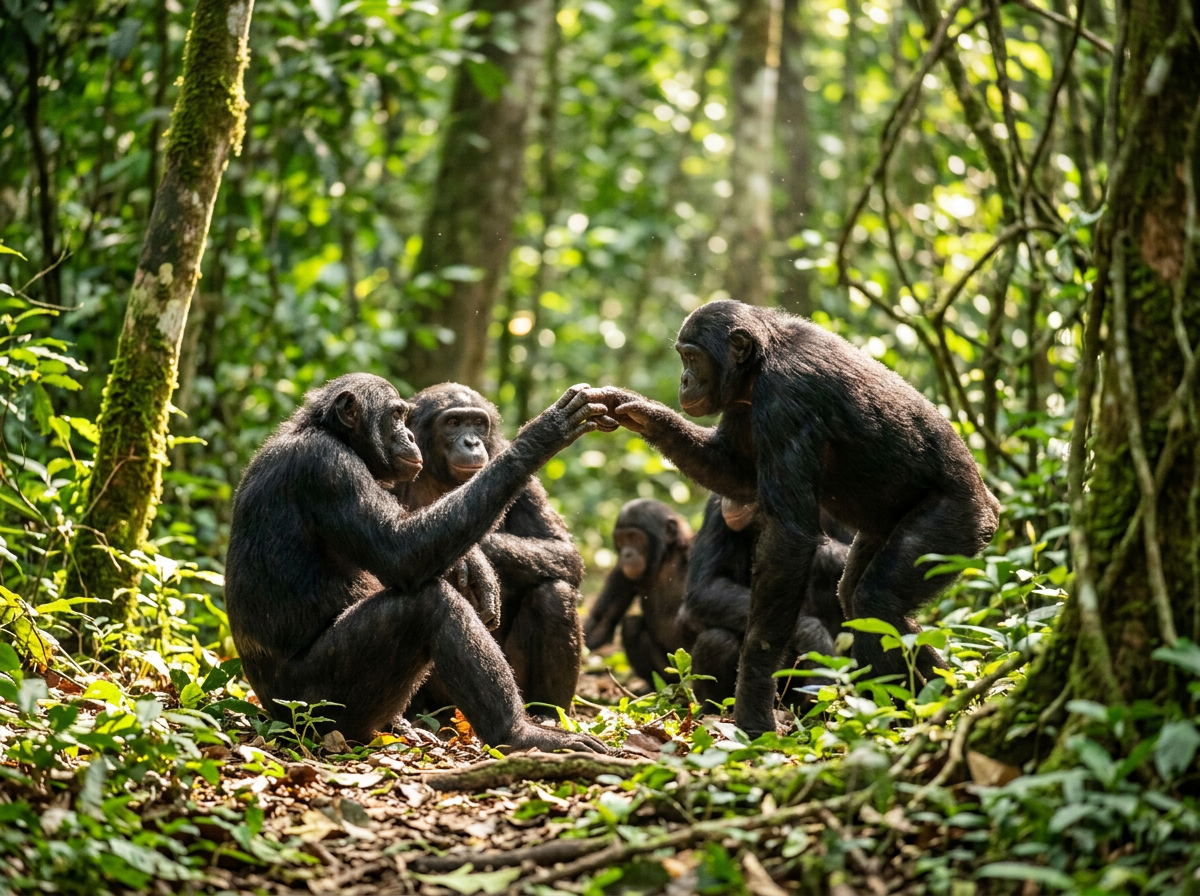
Think of a group of bonobos in a forest sanctuary, waiting. They know the food is coming – a scatter of peanuts, any moment now. It is exactly the kind of situation that usually breeds pushing and squabbling. But imagine what they do in the seconds before it arrives. They turn to one another and touch. A hand laid on a back. An embrace. A kiss. And when the peanuts finally land, they eat side by side, in peace.
That small scene, recorded and published this week, is where I want to begin – because it quietly turned what looked like a slow news week into something worth sitting with. Around it sat a heritage listing, a study from the Odisha hills, and a policy question about who counts as tribal. Four threads, and one question running under all of them: what makes us who we are, and what do we do to hold on to it? Let me walk you through the week.
A deer park becomes World Heritage
Start with the one that made the papers. Sarnath – the deer park near Varanasi where the Buddha gave his first sermon, the Dhammacakkappavattana, and set the wheel of dharma turning – was added to the UNESCO World Heritage List this week, at the 48th session of the World Heritage Committee meeting in Busan. The story ran across several papers through the week, from the wire reports on the 25th onward.
If you have stood there, you know it is not a ruin in the ordinary sense. The Dhamek Stupa still rises over the grounds. Monks and pilgrims still come. And somewhere in the site’s memory sits the Ashokan pillar whose lion capital India chose as its national emblem – the four lions you carry in your pocket every time you hold a coin. So Sarnath is three things at once: an active pilgrimage centre, a national symbol, and an excavated archaeological complex.
That last identity is what makes it interesting to an anthropologist, and not just a tourist. Inscription lays a set of international conservation rules on top of a place that is still worshipped and still being dug. So who decides what gets protected, and for whom? The archaeologist wants the stratigraphy left undisturbed. The believer wants to keep praying. The nation needs a symbol. Heritage, it turns out, is never just about old stones. It is about the living people around them, and the friction between preserving a site and letting it stay alive.
The scholarship here is worth carrying into an answer. It was Alexander Cunningham, the founder of the Archaeological Survey of India, who first surveyed Sarnath; F.O. Oertel who uncovered the lion capital in the 1904–05 season; and Daya Ram Sahni who led the early excavations. When you write about heritage as a social process rather than a pile of artefacts, reach for the culture-historical tradition and the standing debate in cultural resource management about living versus excavated heritage.
📘 Where this sits in your syllabus – Paper 1, 1.3 (branches of Anthropology – Archaeological Anthropology) and 1.8 (Principles of Prehistoric Archaeology; chronology, relative and absolute dating). Paper 2, 3.4 (impact of Buddhism, Jainism, Islam and Christianity on Indian society). Cite Cunningham, Oertel, Sahni. Perfect for an “archaeology and society” or living-heritage answer.
What the apes are telling us
Now the thread I almost missed, and the one my students should love, because two studies landed close together and they rhyme.
The first is fresh off the press. On the 22nd, a team at Durham led by Zanna Clay and Jake Brooker published in the Royal Society’s Proceedings B a study of how our two closest relatives use touch. They worked at two sanctuaries – bonobos at a site in the Democratic Republic of Congo, chimpanzees at one in Zambia – and they had a clever, simple window into stress. Keepers scatter peanuts for the animals to forage, and that scramble for scattered food is a naturally tense, competitive moment. So the researchers watched the five minutes before the peanuts arrived, that charged pause when everyone knows what is coming, and they logged every reassuring touch.
There was a great deal to log. The apes embraced, they kissed, they patted one another, they placed fingers and hands into each other’s mouths, they held on in ways a textbook would blush to describe. Sometimes the contact rippled through the group in what the team called “reassurance trains” – one ape after another folding into an embrace. And here is the finding that matters. The individuals who reassured each other beforehand went on to feed more peacefully, side by side, once the food arrived; the more tolerant groups were the ones showing the most of this preventive touch. Touch here was not consolation after a fight. It was prevention before one. A way of saying, before anything goes wrong, we are alright, you and I.
I love that this held for chimpanzees, who carry a reputation for aggression, as much as for the gentler bonobos. As Zanna Clay put it, “before stressful events, they come together, they reassure each other, they touch each other, they hug each other.” And Jake Brooker’s point is the one for your answer sheet: comparing bonobos and chimpanzees together opens a window onto the evolutionary roots of our own social behaviour. Because these three lineages – chimp, bonobo, human – split from a common ancestor more than six million years ago, the researchers argue this peace-keeping through touch is at least that old. Older than our species. We did not invent the reassuring hand on the shoulder. We inherited it.
The second study is a few weeks older, from late June, but it belongs right beside the first. A group at Warwick, with Chiara De Gregorio and Adriano Lameira, published in Communications Biology an acoustic study of laughter across all the great apes – orangutans, gorillas, bonobos, chimps and us. They found a shared rhythm, an even spacing of sound, that seems to reach back some fifteen million years to a common ancestor. Human laughter has since grown faster and more flexible, but it sits on that same ancient scaffolding. Their point is quietly radical. Speech did not arrive one day like a bolt of lightning. The vocal control it needs was built gradually, on machinery the apes already had.
Put the two together and you have a lovely learning moment. The roots of both our social life and our speech run down into the primate past. Touch that keeps the peace, and a rhythm that would one day carry words – both older than humanity, both still in us. This is exactly what biological anthropology means when it studies primates not as curiosities but as mirrors.
📘 Where this sits in your syllabus – Paper 1, 1.5 (Characteristics of Primates; Primate Behaviour; Comparative Anatomy of Man and Apes) and 7 (Culture, Language and Communication – origin of language); it also feeds 1.4 (biological and cultural factors in human evolution; theories of evolution). Cite Clay and Brooker (Durham, 2026) on touch and De Gregorio and Lameira (Warwick, 2026) on laughter. A superb, current example for any question on why we study primates, or on the continuity between apes and humans.
The tribes of Odisha, and a study worth reading twice
Now the item almost nobody noticed, and the one I would build a whole class around.
A study from Utkal University made a simple plea this week: record the marriage customs of Odisha’s most vulnerable tribal communities before rapid change wipes them out. That is the whole news item. But sit with it, because it opens onto one of the richest reservoirs of tribal ethnography anywhere in the country.
Some context first, because the numbers matter. Odisha is home to thirteen Particularly Vulnerable Tribal Groups – the largest number in any single state, out of seventy-five recognised across India. The category itself has a history worth knowing. It grew out of the Dhebar Commission of 1960-61 and the old label “Primitive Tribal Group,” and it rests on four markers: a pre-agricultural level of technology, low literacy, a stagnant or declining population, and relative physical isolation. Odisha’s thirteen are the Birhor, Bonda, Chuktia Bhunjia, Didayi, Dongria Kondh, Hill Kharia, Juang, Kutia Kondh, Lanjia Saora, Lodha, Mankidia, Paudi Bhuiyan and Saora. Learn four or five of them well and you will never again be caught short of an example.
Take marriage, since that was the study’s subject – the work of Utkal University’s Centre of Excellence in Studies on Tribal and Marginalized Communities, which looked closely at ten of these groups. What it recorded is a small treasury of custom, and the local terms alone are worth learning.
Among the Juang of Keonjhar and Angul, a courtship can begin with a throw. A young man tosses a ripe mango to the woman he wants – the custom they call Am Lesare Kania, marriage by throwing a mango – and if she accepts, the process begins. A lump of mud can do the same work, Kada Lesare Kania. The bride price here, the Pana, was historically all of three rupees, ceremonial rather than commercial.
Among the Paudi Bhuiyan there is Dhuki Pasiba, where a young woman enters the prospective groom’s household and shares its daily work, and the marriage follows once his family accepts her – a match tested through lived compatibility rather than arranged in the abstract.
The payments, everywhere, are the part that repays attention, because they are not really payments. The Birhor and Mankidia speak of Ganang – four hens, two goats, fifty kilograms of rice, and a token of cash. The Bonda’s Ginningleans on cattle and cereals, the wealth of a hill economy. The Didayi’s Gineng, also called Jhola Dabu, brings rice, a goat, cash and a generous pour of sago-palm drink for the community feast. Among the Dongria Kondh the Modar spreads shares not only to the bride’s parents but to her grandmother and to fellow villagers, so the marriage is owned by the whole village and not two families alone. The Kutia Kondh set the maternal uncles beside the parents in their Jala, a quiet reminder of how much the mother’s side counts. The Hill Kharia keep a modest Pana of rice and cloth, the bride price once just two rupees and fifty paise. And among the Lodha, the Kanya Pana has climbed with the times – from five or seven rupees to around five hundred and one – yet it still travels with a goat or a chicken, clothes, and brass utensils, the old logic surviving inside the new figure.
That old logic is the heart of the matter, and it is the study’s central claim. Marriage here, in the report’s own words, “is conceived less as an economic exchange than as the creation of enduring reciprocal relationships between two extended families and their communities.” Read the gifts and they almost translate themselves: rice acknowledges food security, livestock stands for productive wealth, cloth recognises social duty, brass utensils bless a new household. Bride price as reciprocity, not purchase.
The conclusions are worth carrying whole. Marriage, the report argues, remains the institution that holds kinship, social cohesion and cultural identity together in these communities; the customs differ from tribe to tribe, but all rest on the same grammar of reciprocity, and that grammar has proved remarkably tough even as education, migration, religion, markets and state programmes reshape the surface.
Its recommendation is one every anthropologist would sign: document these customs as living intangible heritage, treat them as functioning social systems rather than curiosities, encourage community-led recording, and ensure that any policy reaching into these lives respects dignity, consent and gender equity.
Some of these communities deserve to be known by name, because each is a ready case study.
The Dongria Kondh farm the slopes of the Niyamgiri hills in Rayagada with real skill, coaxing pineapple, banana and turmeric out of the gradient. They believe their god, Niyam Raja, lives in those hills, which makes the whole landscape sacred rather than merely useful. This is the community behind the landmark Niyamgiri case. When a mining company came for the bauxite beneath, the question reached the Supreme Court, which in 2013, in Orissa Mining Corporation v. Ministry of Environment and Forests, did something remarkable — it handed the decision to the village councils themselves. All twelve gram sabhas said no. You cannot mine a god. It remains the textbook illustration of the Forest Rights Act, PESA, community religious rights, and the idea that sacred geography is not negotiable land.
The Bonda of Malkangiri are often called one of India’s oldest surviving Austroasiatic communities, speaking Remo, a language of the Munda family. Their women are unmistakable – shaved heads, heavy rings of aluminium and bead at the neck, the ringa – and they practise shifting cultivation in the highlands. If you need an example of material culture as identity, or of a highland ecology shaping social life, this is it.
The Lanjia Saora of Gajapati and Rayagada cover their walls with ritual paintings, the idital, made to please the deities and the ancestors and to keep sickness from the house. These were the people Verrier Elwin came to love and to write about, and their elaborate religious world is a ready answer to any question on tribal religion, on shamanism, or on Vidyarthi’s Nature–Man–Spirit complex.
And the Birhor and Mankidia are semi-nomadic hunter-gatherers and expert rope-makers, working siali bark into cord, among the smallest and most fragile populations of all, a few hundred each. They are the clearest living example of a pre-agricultural PVTG, and of what settlement and displacement do to such a people.
The scholarship here is deep, so giving the students the whole shelf. Verrier Elwin above all – his Bondo Highlander of 1950 on the Bonda, and The Religion of an Indian Tribe of 1955 on the Saora and their idital. Set him against G.S. Ghurye, whose The Scheduled Tribes argued that India’s tribes were essentially “Backward Hindus” already being absorbed into the mainstream. That opposition – Elwin’s protectionism against Ghurye’s assimilationism – is the great Ghurye–Elwin debate that runs beneath every serious question on tribal policy. Add F.G. Bailey, who did his fieldwork in exactly this part of Odisha and left us Caste and the Economic Frontier on the village of Bisipara in Kondh country, along with Tribe, Caste and Nation. Then L.P. Vidyarthi, whose Nature–Man–Spirit complex explains why a hill can be a deity; N.K. Bose, who described the “Hindu method of tribal absorption”; and B.K. Roy Burman, who worked on the very classification that produced the PVTG category.
📘 Where this sits in your syllabus – Paper 2, 9.1 (concept of PTGs/PVTGs – distribution and special programmes; tribal administration, PESA and the Forest Rights Act), 6.1 (tribal situation in India – bio-genetic, linguistic and socio-economic characteristics, and classification), 6.2 and 6.3 (land alienation, developmental projects and displacement – the Niyamgiri case), and 3.3 (Sacred Complex and Nature–Man–Spirit Complex). Paper 1, 2.3 (Marriage – types of marriage, marriage regulations, and marriage payments / bride wealth) and 2.5 (Kinship – descent and alliance, and the weight given to the mother’s brother in the Kutia Kondh Jala). Scholars: Elwin, Ghurye, Bailey, Vidyarthi, Bose, Roy Burman. The richest item of the week.
When identity meets conversion
The last thread is a policy question with a long tail. Early in the week, Maharashtra set up a committee to examine whether members of a Scheduled Tribe who convert to another religion should keep the benefits that come with that status.
It sounds technical. It is really a question about what tribal identity is. Is it your faith, your descent, or your culture? The law has an answer, and it is worth knowing its whole history rather than just the headline. Tribal status rests on the criteria the Lokur Committee laid down in 1965 – indications of primitive traits, a distinctive culture, geographical isolation, shyness of contact, and general backwardness. Notice that not one of those is religious. So a tribal who changes religion is still, in the eyes of that definition, tribal.
Now compare the Scheduled Castes, where the story runs the other way entirely. The Constitution (Scheduled Castes) Order of 1950 originally confined that status to Hindus, later stretching it to Sikhs in 1956 and Buddhists in 1990, but never to Christians or Muslims. So a Dalit who converts out can lose the protection. The Ranganath Misra Commission recommended in 2007 that we cut this link between caste and religion altogether. That recommendation still sits on a shelf, unimplemented. Hold the two rules side by side and the deeper logic surfaces: caste is treated as a religious identity, tribe as a cultural one. Maharashtra’s committee is examining exactly that seam.
There is a strong shelf of scholars for this one too. The Xaxa Committee of 2014, chaired by Virginius Xaxa, worried precisely about the erosion of tribal identity. For the tribe–caste continuum, reach for Surajit Sinha’s work on the Bhumij and their slow movement from tribe towards caste, N.K. Bose’s “Hindu method of tribal absorption,” and again F.G. Bailey. On whether tribes should be left alone, absorbed, or integrated, the Ghurye–Elwin debate returns, and behind it Nehru’s “tribal panchsheel,” set down in his foreword to Elwin’s A Philosophy for NEFA. Christoph von Fürer-Haimendorf, who spent decades among India’s tribes, argued firmly for their right to survive on their own terms.
📘 Where this sits in your syllabus – Paper 2, 7.1 (problems of exploitation and deprivation of SC, ST and OBC; constitutional safeguards for STs and SCs), 3.2 (caste system – the tribe–caste continuum), 7.3 (ethnicity and problems of tribal integration – the assimilation-versus-integration debate, Nehru’s Panchsheel), and 3.4 with 8.1 (impact of Christianity and Islam, and of religion on tribal societies). Cite the Lokur Committee (1965), the SC Order (1950), the Ranganath Misra Commission (2007), and the Xaxa Committee (2014). A ready “current example” for identity and classification.
What ties the week together
I began with those bonobos reaching for each other in the seconds before the food fell, and I want to end there too, because the whole week rhymes with that gesture. A deer park we are trying at once to protect and to keep alive. Marriage customs in the Odisha hills that a family renews with a gift of rice and cloth. A tribal identity that holds even when the religion around it changes. And two apes touching, before anything has gone wrong, to say we are alright.
Every one of these is a way of holding on – to a place, to a custom, to a name, to each other – while the world reaches in to change it. That reaching-out is not ours alone; it is six million years old, maybe fifteen. Anthropology is simply the discipline that takes it seriously, in a stupa and in a sanctuary alike. A quiet week, and it held all of it.
Written for my students of Anthropology optional – but honestly, for anyone who finds people, and their nearest relatives, endlessly interesting. See you next Sunday.
Sources
Sarnath inscribed on the World Heritage List
- UNESCO – Ancient Buddhist site of Sarnath inscribed on the World Heritage List
- The News Insight – Evening news headlines, 25 July 2026
Great apes and touch; the roots of speech
- Durham University – Great apes were using touch to reassure and keep the peace
- Phys.org – New study into humans’ closest ape relatives suggests physical touch can promote social harmony
- ScienceDaily – Great ape laughter reveals a hidden origin of human speech
- Neuroscience News – Great ape laughter reveals clues to human speech origins
The tribes of Odisha and the marriage study
- The Indian Tribal – Inside the marriage traditions of Odisha’s most vulnerable tribal groups
- OrissaPost – Odisha’s 13 Particularly Vulnerable Tribal Groups
Maharashtra and the conversion question


Leave a Reply